"It's too expensive" is the objection every salesperson hears, and the one most often answered badly. The usual reflexes, defending the price or offering a discount on the spot, tend to cost you either the deal or the margin.
The better approach starts from a simple idea: a price objection is usually a value question in disguise. The buyer is telling you they don't yet see enough to justify the cost. Your job is to find out which part is missing.
Below are six replies that keep the conversation going, and what call data says about when price should come up at all.
First, bring price up earlier than feels comfortable
Many reps avoid price until the buyer forces it, hoping more value will have been built up by then. The data points the other way. Gong analyzed 11,331 sales opportunities, each with at least three recorded calls, and compared win rates by when pricing was first discussed:
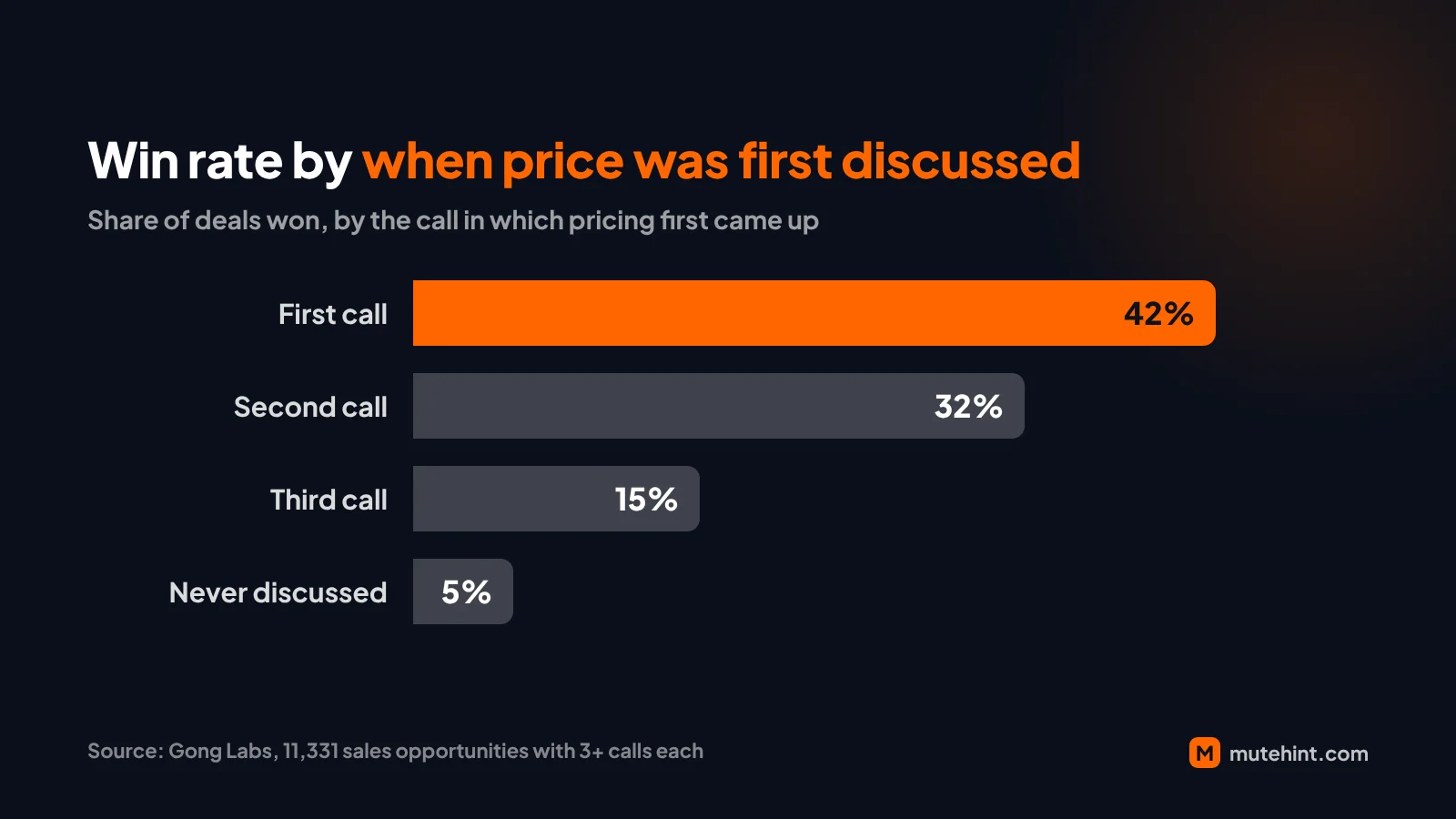 Deals where price was raised on the first call won far more often. Source: Gong Labs.
Deals where price came up on the first call won 42% of the time; deals where it never came up won 5%. Gong found it made no difference whether the buyer or the seller raised it. That's a correlation, not proof that mentioning price wins deals. It does suggest that buyers who can talk about price early are serious, and that dodging the topic doesn't help.
The practical lesson: give a ballpark on the first call, roughly three-quarters of the way through, once you understand the problem. A price objection on call one is far easier to handle than the same objection after three calls of work.
Six replies to "it's too expensive"
1. Ask what they're comparing it to
"Too expensive compared to what: another tool, doing it in-house, or not doing it at all?"
"Expensive" only means something next to an alternative. The answer tells you which conversation you're actually in: competition, building it themselves, or the status quo.
2. Go back to the cost of the problem
"Earlier you said the team loses about ten hours a week on this. What does that cost you in a quarter?"
This only works if you asked about the problem's cost during discovery. When the cost of doing nothing is on the table, your price has something to be measured against.
3. Separate budget from value
"Is it that the price is more than the result is worth to you, or that it's more than you have budgeted right now?"
These are two different problems. "Not worth it" means you haven't shown enough value. "Not in the budget" is about timing, approval or structure. That might be solved by a smaller start, a later start date, or the budget owner joining the next call.
4. Trade, don't discount
"I can't move on the price, but if a shorter contract or fewer seats would help, let's look at that."
If you cut the price the moment someone pushes, you've taught them that pushing works. If you have room to move, ask for something in return: a longer commitment, a case study, a faster signature.
5. Check whether price is the real reason
"If price weren't an issue, is this the solution you'd choose?"
If they hesitate, price isn't the real objection. Something else is, and no discount will fix it. Ask what's holding them back.
6. Let a pause do the work
After you answer, stop talking. Many reps fill the silence by adding a discount nobody asked for. A few seconds of quiet gives the buyer room to tell you what's really on their mind.
What makes this hard on a live call
None of these replies is complicated. What makes them hard is timing: the objection lands, the buyer is waiting, and the reply you'd have given easily in a role-play doesn't come to mind. That's why the best preparation is practice: write down the three objections you hear most, script a first sentence for each, and say them out loud before your next call.
Some reps also keep a cheat sheet next to the call window. A live call assistant does the same job automatically. MuteHint's Sales Call profile hears the objection and shows a short suggested reply on your screen, built from the pitch and notes you paste in before the call. It doesn't join the call, and only you see it.
Whatever you use, the principle is the same: treat "too expensive" as the start of a conversation about value, not the end of the deal.